Samsung Leejung Women's Clinic Doctor's Column
Obstetrics & Gynecology Column

Vaginal Dryness: Can a Vagisoft Procedure Help?

What causes vaginal dryness, how the Vagisoft procedure works, and the criteria used to judge whether it suits you.

Published 2026-09-23 Updated 2026-09-23 Reviewed by Hyejeong Lee, Medical Director · Obstetrics & Gynecology Specialist

Vaginal dryness brings pain and a feeling of friction during intercourse, and it often comes with vaginitis that keeps returning despite treatment. It is widely thought of as a menopausal symptom, but childbirth, recurring vaginitis and hormonal changes mean it can appear just as easily in your 20s.

This article sets out what causes vaginal dryness, how the Vagisoft procedure works, and why it does not suit everyone. In short, Vagisoft uses hyaluronic acid and related ingredients to help the mucosa recover moisture and elasticity, but depending on the cause, a different approach may be needed first.

01

Why does vaginal dryness happen?

Key point
Vaginal dryness is not only about the hormonal changes of menopause. Childbirth, recurring vaginitis and hormonal imbalance can all produce it, and because those causes are not age-bound it can appear in your 20s as well. Because the causes overlap so often, one factor alone rarely explains the whole picture.

Vaginal dryness is commonly thought of as a symptom of menopause, but in practice it comes from several directions. Vaginal tissue and mucosa can be damaged or stretched during childbirth, which reduces their ability to hold moisture and elasticity, and when the mucosa has become sensitive through repeated vaginitis, dryness and a feeling of friction often appear together.

Hormonal change is not tied to age, so it is not unusual for women in their 20s or 30s to come in describing pain during intercourse or a dry sensation. These causes frequently overlap, so the picture cannot always be explained by a single factor.

  • Childbirth — vaginal tissue and mucosa can be damaged or stretched, reducing elasticity
  • Recurring vaginitis — the mucosa becomes sensitive, vulnerable to irritation and prone to dryness
  • Hormonal change — not tied to age, so symptoms can appear in your 20s
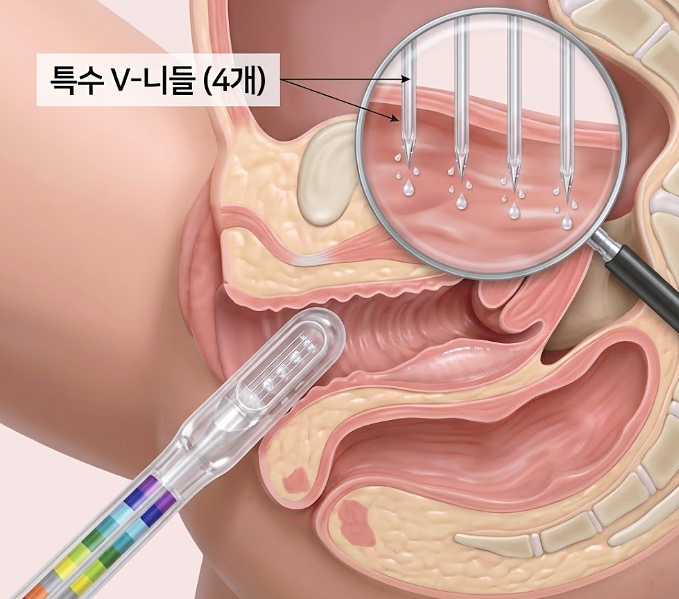
Anatomy illustration related to Vaginal Dryness: Can a Vagisoft Procedure Help?
02

How does Vagisoft work, and how effective is it?

Key point
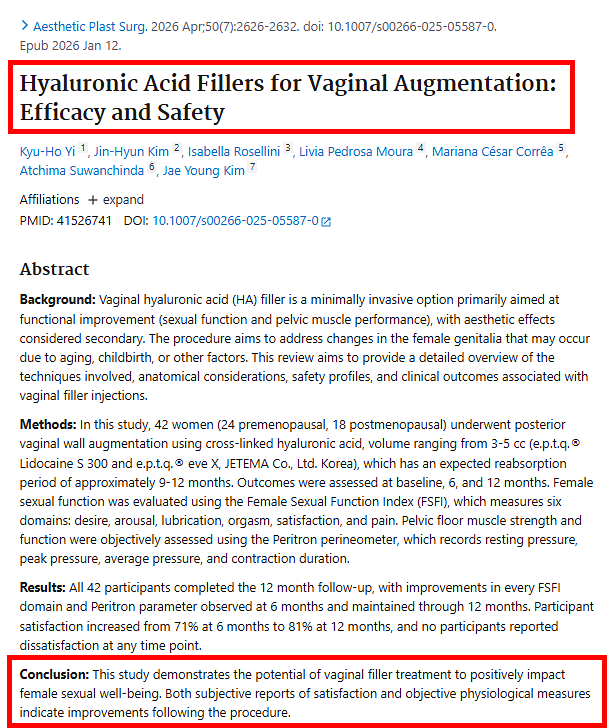
Vagisoft uses a V-needle and negative pressure to deliver the solution evenly across the treatment area. In the published research, 71% of participants were satisfied at 6 months and 81% at 12 months. The solution is centred on hyaluronic acid, and the delivery method is what spreads it evenly rather than in a single concentrated spot.

Vagisoft uses a device with a V-needle carrying four micro-needles to deliver the solution to several points inside the vagina. An automatic injection system based on negative pressure spreads it evenly and at regular intervals across a wider area than an ordinary syringe, and the ingredients are centred on hyaluronic acid combined with PN, PDRN and PDLLA.

A paper analysing changes after the injection of a hyaluronic acid biomaterial into the vagina followed 42 participants, 24 premenopausal and 18 postmenopausal, looking at desire, lubrication, pain and pelvic floor function. It reported that 71% were satisfied at 6 months and 81% at 12 months, with no dissatisfaction recorded at any point.
Research material related to Vaginal Dryness: Can a Vagisoft Procedure Help?
Related research
03

Is Vagisoft right for everyone?

Key point
Vagisoft can help when dryness is pronounced or intercourse is painful, but if labial hypertrophy or inflammation is present as well, a different approach is needed first. It is not 100% suitable for every patient. The state of the mucosa and the degree of laxity decide the mix, the volume and the number of sessions.

Vagisoft can help when the sensation of dryness is severe, when intercourse is painful, or when repeated vaginitis has left the mucosa sensitive. Where the dryness is caused by labial hypertrophy, however, making the mucosa moist may not stop the symptom returning through friction, and an approach that restores the structure may suit better.

If the procedure is carried out while inflammation is present, the tissue response can be strong, so managing the inflammation first is necessary. The mix of ingredients, the total volume, the area treated and the number of sessions also have to be set individually according to the state of the mucosa and the degree of laxity.

  • Marked dryness — helpful when daily discomfort and a feeling of friction come together
  • Pain during intercourse — relief can be expected where the pain is recurrent
  • Sensitive mucosa from repeated vaginitis — helps mucosa that has become vulnerable to irritation

Hyejeong Lee, Medical Director
Doctor's view

How the doctor decides

Hyejeong Lee, Medical Director · Obstetrics & Gynecology Specialist

I look for the cause before the symptom

Even when a patient describes vaginal dryness, I do not assume the cause is always the same. Where something structural such as labial hypertrophy sits behind the dryness, I suggest an approach aimed at that cause rather than Vagisoft, and I decide about the procedure only after the cause is clear.

If there is inflammation, treatment comes before the procedure

When friction and irritation have left inflammation as well, I do not start with the procedure. Treating while inflammation is present can produce a strong tissue response, so in that case I manage the inflammation first and reassess once the condition has settled.

I design the mix and the number of sessions for each patient

Even with the same procedure, I do not apply the same mix of ingredients, total volume, treatment area and number of sessions to everyone. Where the mucosa is thin or laxity is marked I add ingredients aimed at elasticity, and where recovery is slow I adjust the interval and the number of sessions.

I do not present it as suitable in every case

Even though Vagisoft is a helpful procedure, I do not tell patients it is 100% suitable for everyone. A satisfying result follows only when we check together whether the procedure matches the symptom you have now and whether it can be designed around your condition.

Summary

In summary

Vaginal dryness can arise not only at menopause but from childbirth, recurring vaginitis and hormonal change. Vagisoft uses a V-needle and negative pressure to deliver hyaluronic acid and related ingredients evenly, helping the mucosa recover moisture and elasticity, and the published research recorded satisfaction in 71% of participants at 6 months and 81% at 12 months. It is not 100% suitable for everyone, however: where labial hypertrophy or inflammation is also present, another approach is needed first. If pain during intercourse or dryness keeps returning, it is worth a consultation where both the cause and your overall condition can be assessed.

FAQ

Frequently asked questions

QDoes vaginal dryness only affect women who have reached menopause?
A

No. Childbirth, recurring vaginitis and hormonal change mean it can appear in women in their 20s and 30s as well.

QHow long do the effects of Vagisoft last?
A

The published research reported satisfaction in 71% of participants at 6 months and 81% at 12 months, with no participant expressing dissatisfaction during that period. Results can still differ with the state of the mucosa and the degree of laxity.

QCan I have Vagisoft if I have labial hypertrophy?
A

If labial hypertrophy is the cause of the dryness, making the mucosa moist may not stop the symptom returning through friction, and an approach that also restores the structure may suit better. The cause needs to be identified first.

QWhat should be checked before the procedure?
A

The cause of the discomfort you feel now, along with the state of the mucosa and the degree of laxity, needs to be assessed first. The mix of ingredients, the volume, the area and the number of sessions are then designed around that.

Hyejeong Lee, Medical Director
Medical review
Hyejeong Lee, Medical Director · Obstetrics & Gynecology Specialist
This content is general medical information and may not apply to every individual. Diagnosis and treatment are decided through a consultation.