When a health check-up shows a positive HPV result, cervical dysplasia or a CIN1 or CIN2 finding, cancer tends to be the first worry. Cervical cancer, however, develops through precancerous lesion stages, so such a finding does not mean cancer straight away, and responding according to the stage allows it to be managed adequately.
This article sets out how HPV infection progresses to cervical cancer, how PDT photodynamic therapy works, and how to manage things after treatment.
How does a positive HPV result progress to cervical cancer?
The main cause of cervical cancer is the human papillomavirus, HPV, and even when infection occurs, most cases clear naturally through the immune response. When a high-risk type such as HPV16 or 18 leads to persistent infection, however, it develops into dysplasia, which is divided into three stages, CIN1, CIN2 and CIN3, according to how far it has progressed. Once it reaches a severe stage such as CIN3, it can progress through carcinoma in situ to cervical cancer.
With HPV infection, follow-up is prioritised at first, bearing in mind that it may clear by itself. If regular check-ups detect a high-risk type repeatedly and it has not cleared for close to 2 years, however, active treatment is recommended instead of follow-up, to reduce the risk of it leading to dysplasia.
- CIN1 — an early stage with mild changes in cervical cells; follow-up is prioritised
- CIN2 — moderate dysplasia; treatment is considered depending on whether it persists
- CIN3 — severe dysplasia; if left alone it can progress through carcinoma in situ to cervical cancer
How does PDT photodynamic therapy work?
LEEP (cone excision), which cuts out or burns cervical tissue, shortens the cervix and can raise the risk of infertility or preterm birth. PDT instead uses a non-invasive laser to remove only the dysplastic tissue, preserving cervical function and helping to keep pregnancy and childbirth possible. The equipment can also be used at the CIN1 or CIN2 stage, making it a means of intervention that reduces the risk of progression to CIN3 or invasive cancer if the condition were left alone.
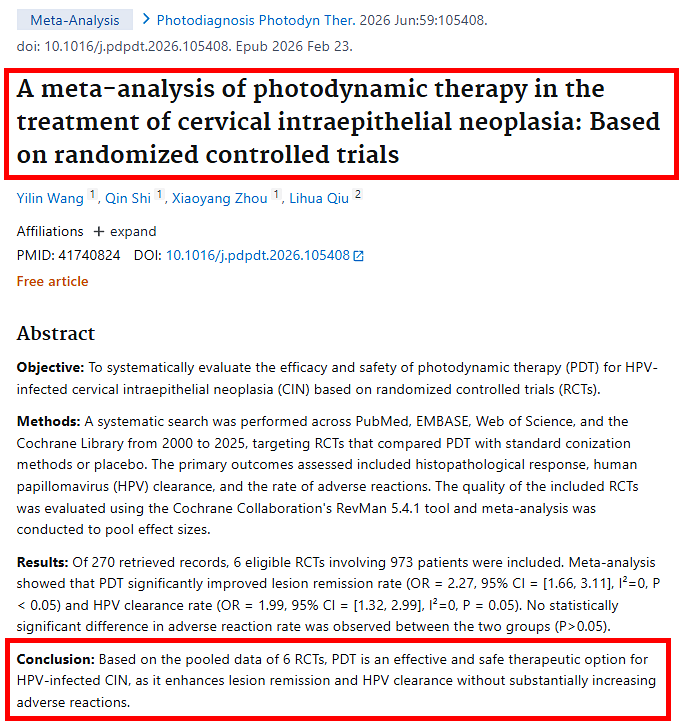
The light of the PDT laser acts not only on the lesion but across the whole surrounding micro-area, which can lower the likelihood of recurrence. It also has an anti-inflammatory action, and with just 7 minutes of irradiation it is also used to treat vulvar symptoms such as itching and vaginal dryness. A study analysing controlled trials involving 973 participants also found that photodynamic therapy significantly improved lesion remission rates and HPV clearance rates.
- Preserves normal cells — removes only the lesion tissue selectively, leaving the surrounding normal tissue
- Preserves cervical function — no change in cervical length, so less effect on pregnancy and childbirth
- Anti — inflammatory effect — 7 minutes of irradiation alone is used to treat vulvar itching and vaginal dryness
What still needs checking after treatment?
However effective the PDT laser may be, a body that has already been infected with HPV carries a possibility of recurrence of at least 1% at any time. After treatment, regular checks are needed to see whether HPV is detected again, with re-treatment where needed. If checks are delayed, it can lead on to cervical cancer, so regular check-ups remain essential.
Even where HPV infection has already occurred, receiving vaccination after treatment is helpful, because with so many types of HPV a cross-protective effect from the vaccine can be expected. Even with a positive HPV result, management and treatment differ according to the risk type, and dysplasia treatment also needs to be designed differently according to age and speed of recovery.